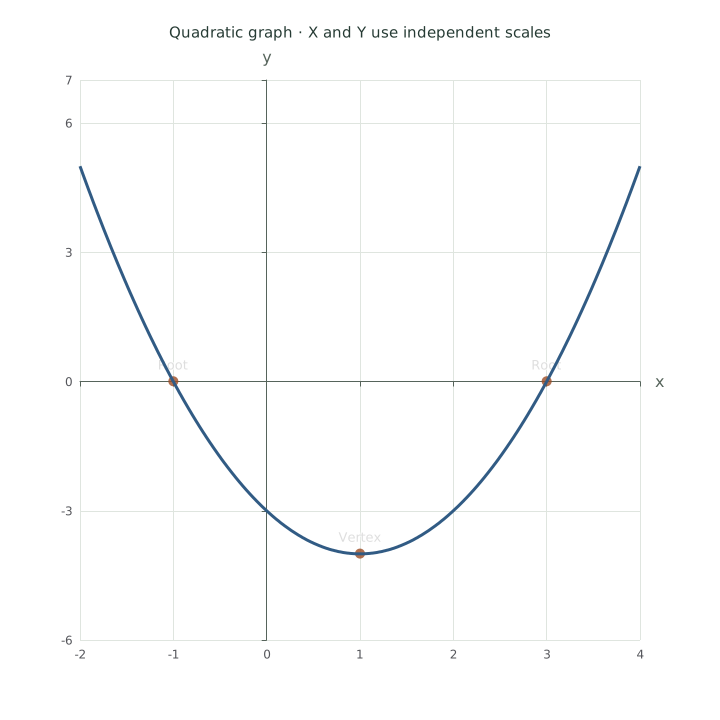
Graph a quadratic in the form y = ax² + bx + c. Enter its three coefficients to see the parabola, vertex, axis of symmetry, real roots and y-intercept. A calculated table connects the equation to the curve, and practice mode creates a printable graphing exercise.
EXPLORE · PRACTISE · PRINTFree · No signup · Stays on your device
2 See how it works
Loading controls…
y = (1)x² + (-2)x + (-3)
Step by step
Vertex (1, -4); symmetry line x = 1
Opens up; y-intercept (0, -3)
Discriminant b² − 4ac = 16
Real roots: -1, 3
Five calculated points around the vertex
X
Y
-1
0
0
-3
1
-4
2
-3
3
0
The curve uses 401 evenly spaced samples plus exact vertex/root X positions. Axes use independent scales to keep the vertex, intercepts and real roots visible. Labels round to 8 significant digits; CSV retains calculated precision. Real roots only.
3 Download & use it
PDF includes the problem and space to work. Practice mode can add a separate answer key; Explore mode gives a worked page.
SVG and PNG match the diagram currently shown. CSV includes calculated values, even in practice mode.
Practice PDF page 1 keeps the answers hidden, even after revealing them on screen. PDF pages use high-resolution images.
How to use it
Enter a, b and c from y = ax² + bx + c. Use the sign as part of each coefficient: x² − 2x − 3 has a = 1, b = −2 and c = −3.
Read the vertex, discriminant and real roots. Move c with the slider to shift the parabola vertically and watch the intercepts change.
Choose Practice mode to sketch the graph and calculate the features yourself. Download an A4 or Letter worksheet with an optional answer page.
One equation. A vertex. Two crossings.
For y = x² − 2x − 3, the vertex X coordinate is −b/(2a) = 1. Substituting x = 1 gives y = −4, so the vertex is (1, −4) and the axis of symmetry is x = 1.
The discriminant is (−2)² − 4(1)(−3) = 16. The real roots are −1 and 3, equally spaced from x = 1. Since a is positive, the parabola opens upward. At x = 0, y = −3, giving the y-intercept.
Free for class, homework and presentations. Two-page PDFs: question first, answer key second. Print in portrait at 100% / Actual size.
Understand the result
Find the vertex and direction
For a nonzero quadratic coefficient a, the vertex has h = −b/(2a) and k = ah² + bh + c. Its symmetry line is x = h. Positive a opens upward with a minimum; negative a opens downward with a maximum. The coefficient c gives the y-intercept directly.
Use the discriminant to understand roots
D = b² − 4ac determines the real roots. A positive value gives two distinct real roots, zero gives one repeated real root, and a negative value gives no real roots. The calculator uses the quadratic formula with a numerically stable rearrangement. Results are numerical approximations, not symbolic proofs; complex roots are not displayed.
Read the scales before comparing shapes
The plotted window includes the vertex, y-intercept and any real roots. X and Y use independent scales, so the curve’s apparent width can change when the window changes. Read the tick values instead of comparing width between separate exports. The curve joins 401 evenly spaced samples and includes the computed vertex and root positions.
Input and download limits
Enter coefficients rather than a free-form equation. The absolute value of a must be from 0.1 to 10; b and c must be between −20 and 20. Fractions and dot decimals work. At a = 0 the expression is linear, so this quadratic tool asks for a nonzero value. The CSV provides five calculated points centred on the vertex; PNG and SVG contain the graph, while PDF contains the worksheet or worked solution.
Further reference: OpenStax: quadratic functions. Examples, tool design and practice sheets on this page are original ChartsAI work; no affiliation is implied.
The controls accept standard-form coefficients. Expand y = a(x − h)² + k first: b = −2ah and c = ah² + k. For example, y = (x − 1)² − 4 becomes y = x² − 2x − 3.
Why does my graph have no x-intercepts?
When b² − 4ac is negative, the quadratic has no real roots. The parabola stays above or below the x-axis. Try the No real roots preset to see an example.
Can students check an answer without seeing it immediately?
Yes. Practice mode shows the equation and a blank graph window. Reveal answers displays the curve and calculations. The PDF question page remains blank even after the screen answers are revealed.