Choose a skill. Get a fresh set of questions. Print a worksheet with space to work and a separate answer key. Practice negative numbers, fractions, or addition and subtraction on equally spaced number lines.
Read and plot integers from −10 to 10. Alternate between locating a given number and identifying a marked point.
Set 20260908. Changing paper size keeps the same questions.
3 Download your worksheet
2 question pages + 2 answer pages. Three questions per page, with working space.
2 Question sheets
Read this page as text
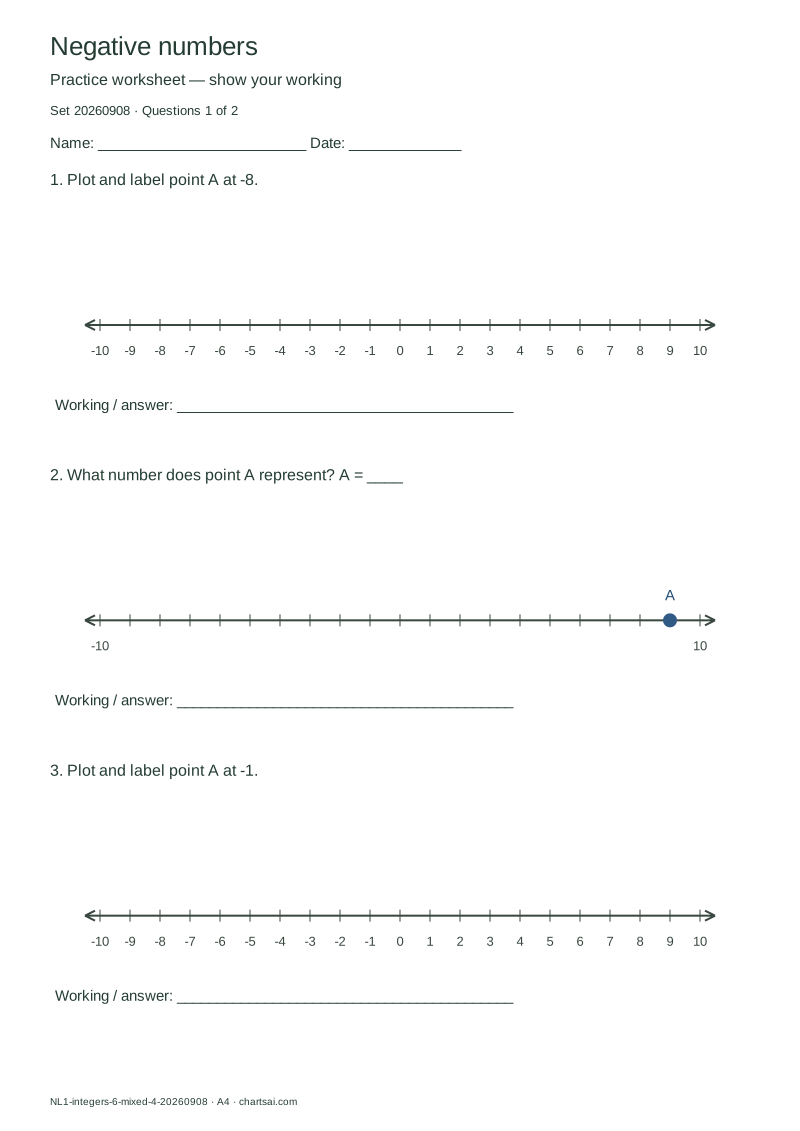
Plot and label point A at -8. Number line from -10 to 10, equal steps of 1.
What number does point A represent? A = ____ Number line from -10 to 10, equal steps of 1.
Plot and label point A at -1. Number line from -10 to 10, equal steps of 1.
Reading a marked point is a visual exercise. The text lists the task and scale; preview the key to read its answer.
NL1-integers-6-mixed-4-20260908 · Print at actual size (100%). Question PDFs always hide worked answers, even while previewing the key.
From a topic to a printable lesson
Choose a practice pack and question count. Use 6, 9 or 12 exercises. For integers and fractions, choose reading marked points, plotting given values, or both. Fraction steps can be halves, quarters, fifths or tenths.
Generate a fresh set when you need another version. Each set uses distinct exercise specifications; a value can recur on a different fraction window. Paper size and answer-key settings keep the questions unchanged.
Check the preview, then download. A4 and US Letter PDFs place three questions on each page. Answer pages follow all the question pages, so you can print or distribute them separately. Print at 100% scale.
For one custom diagram, decimal steps, blank lines or open and closed intervals, use the number line generator. This worksheet builder creates bounded practice sets; it does not accept arbitrary equations or grade student responses.
Three ways to practice
Each free pack includes six original questions and a matching answer key: two question pages followed by two answer pages. The fraction pack starts with quarters. These files work without JavaScript.
Negative numbers
Read and plot integers from −10 to 10. Alternate between locating a given number and identifying a marked point.
Try this: Locate zero first. Each tick to the left is one less; each tick to the right is one more.
Worked example: A point three ticks left of zero has value −3. The point −7 is farther left because −7 is less than −3.
Watch for: Distance from zero does not determine which number is greater. −7 has a larger distance from zero than −3, but a smaller value.
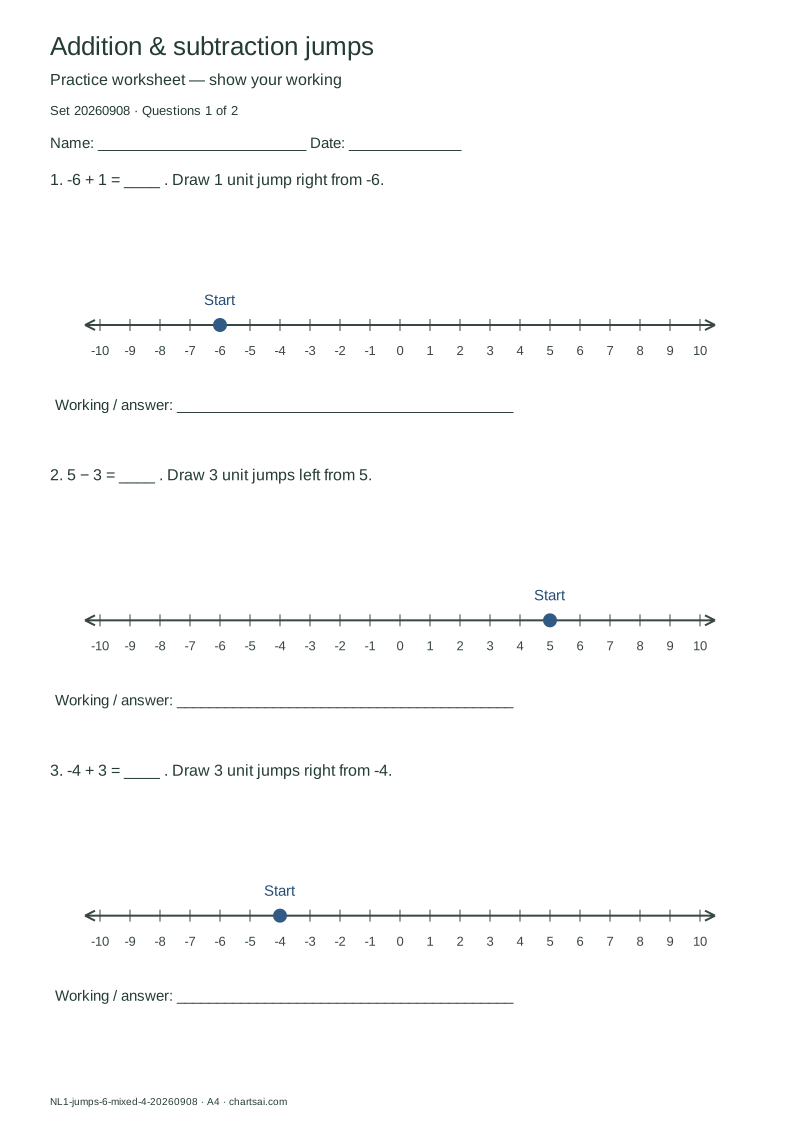
Add or subtract 1–6 using unit jumps. Starting points and answers stay between −10 and 10; sets include both operations.
Try this: Begin at the first number. Addition moves right; subtracting a positive number moves left. Draw one jump for each unit.
Worked example: For −2 + 5, start at −2 and jump right five times: −1, 0, 1, 2, 3. The answer is 3.
Watch for: The starting point is not the first jump. Count the moves between ticks. These sheets subtract positive operands; subtracting a negative is outside this pack.
The generator selects from a finite pool of valid exercises using a reproducible set number. Integer lines run from −10 to 10. Fraction lines span two units within 0–5, with equal fractional steps. Jumps use addition or subtraction of positive integers from 1 to 6, and both the starting value and answer remain between −10 and 10.
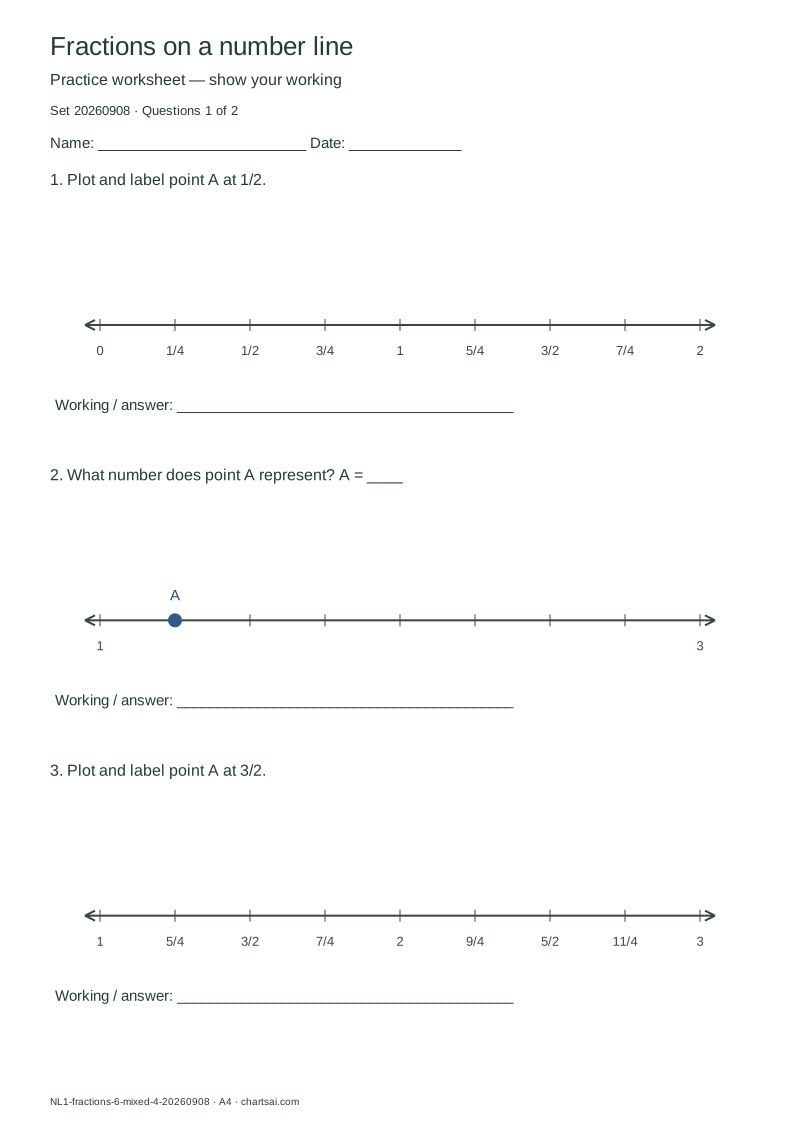
On reading questions, only the two endpoint values are labelled. Learners determine the step size from the spaces and identify point A. On plotting questions, every tick is labelled and learners place the given point. The key shows the point and its value. Fraction answers are simplified, so 2/4 appears as 1/2; equivalent answers are valid.
Question and answer pages share the same number-line geometry used by the interactive diagram tool. The PDF uses high-resolution page images rather than selectable text. The CSV provides the questions and answers as text. Screen previews shrink to fit; the printed page is the intended working size.
Questions about printing and practice
Can I download only the questions?
Yes. Uncheck “Include separate answer pages” before downloading a generated PDF. The ready-made packs include both sections; print only pages 1–2 if you want their questions alone. Previewing an answer key never adds answers to the question sheets.
Can I make another version of the same activity?
Use “Generate fresh questions.” The topic, question count and fraction steps stay the same while the set changes. A new set may reuse some numbers, but each worksheet avoids duplicate exercises. Changing the paper size preserves the set.
Which ages or grades are these for?
Choose by the skill a learner is practicing. There is no grade-level certification or claim of curriculum alignment. An adult should review the preview for the learner's needs, especially negative values and fractions greater than one.
Are these free for a class or home lesson?
Yes. Download, print and share these original practice sheets for teaching or independent study. There is no account, watermark over the questions, or upload required. Worksheet generation runs in your browser.