How to read this chart
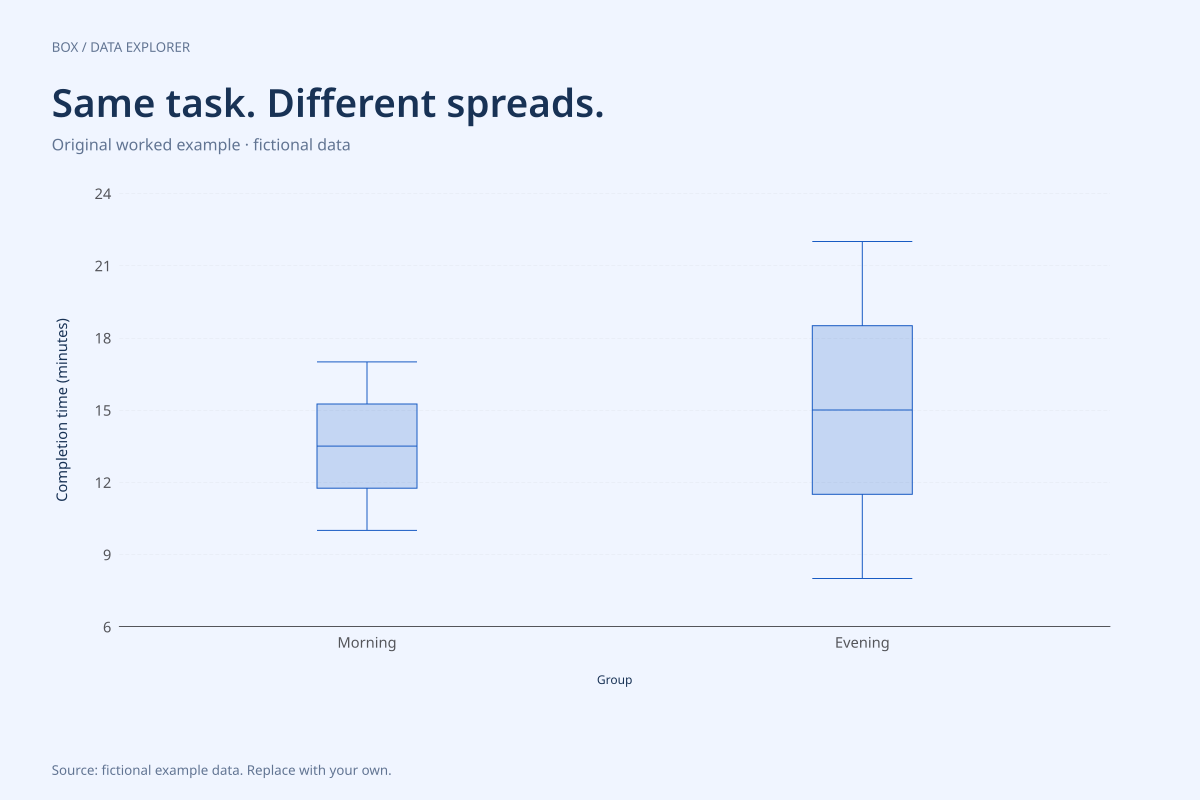
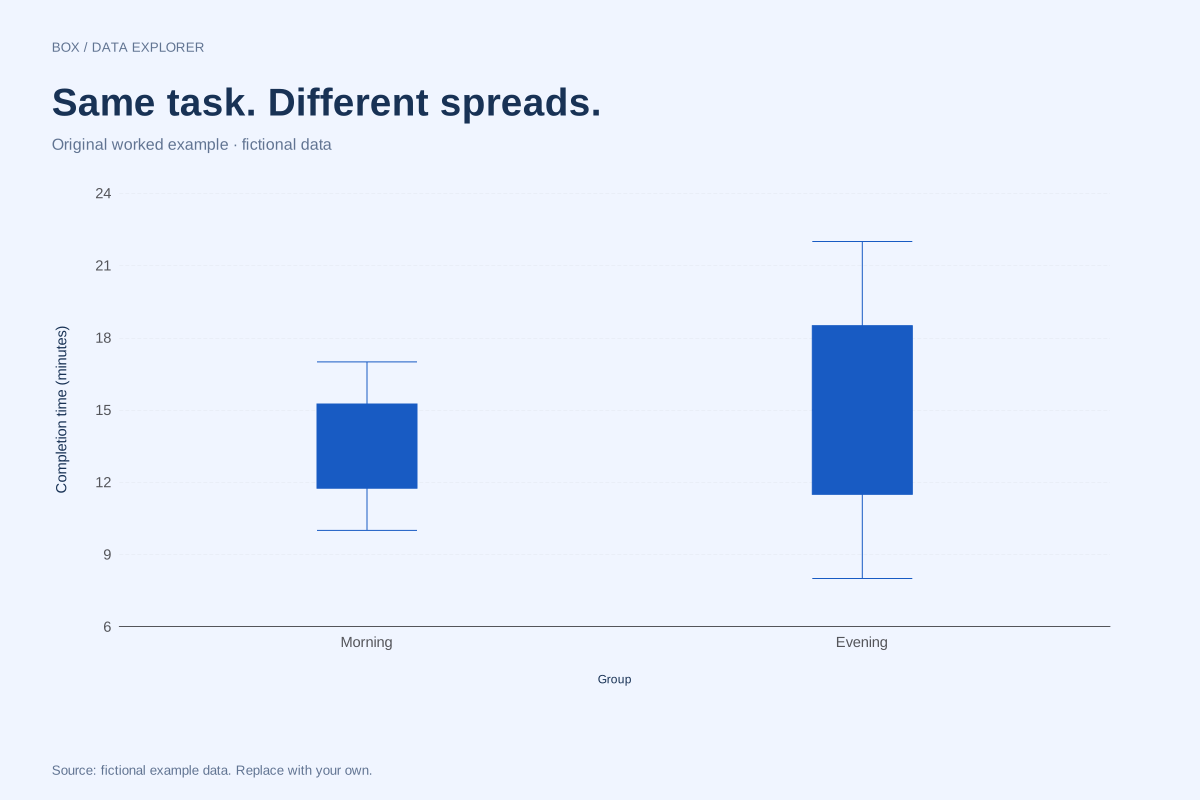
Using linear-interpolated quartiles, morning has Q1 11.75, median 13.5 and Q3 15.25 minutes. Evening has Q1 11.5, median 15 and Q3 18.5 minutes. Their IQRs are 3.5 and 7 minutes respectively.
The morning observations range from 10 to 17; evening ranges from 8 to 22. No value lies beyond its group’s 1.5 × IQR fences, so whiskers reach the observed minimum and maximum in this particular example. That outcome follows from the values, not a universal definition of a whisker.
Try the calculation yourself
Compare the medians first, then compare the box lengths and full ranges. Because both samples have N = 8, unequal sample size is not a factor here. If you replace the data with uneven groups, keep the group labels repeated on each row and read N from the calculated table.
Open this exact example, change the data or calculation settings, and compare the result. The CSV preserves the input rows; the ECharts JSON contains drawing options.
What this example cannot tell you
The fictional groups do not demonstrate a time-of-day effect. A box plot has no information about assignment, task difficulty or uncertainty, and the editor does not test whether a difference is statistically significant.
Does a taller box mean more observations?
No. The box length along the numeric axis represents the interquartile range. In this chart the boxes have the same visual width, and sample counts are reported separately. Evening’s larger box describes spread, not a larger group.
Calculation convention
The default uses linear interpolation at rank (n − 1)p in the sorted sample, equivalent to R quantile type 7. At p = 0.25, 0.5 and 0.75 this gives Q1, the median and Q3. The alternate method takes medians of the lower and upper halves, excluding the middle observation when the sample size is odd. These methods can give different results for the same small sample.
Method background: NIST: box plot and fence interpretation. R documentation: quantile methods.
Created by SupaMakers for ChartsAI · September 8, 2026. Source and reuse terms.